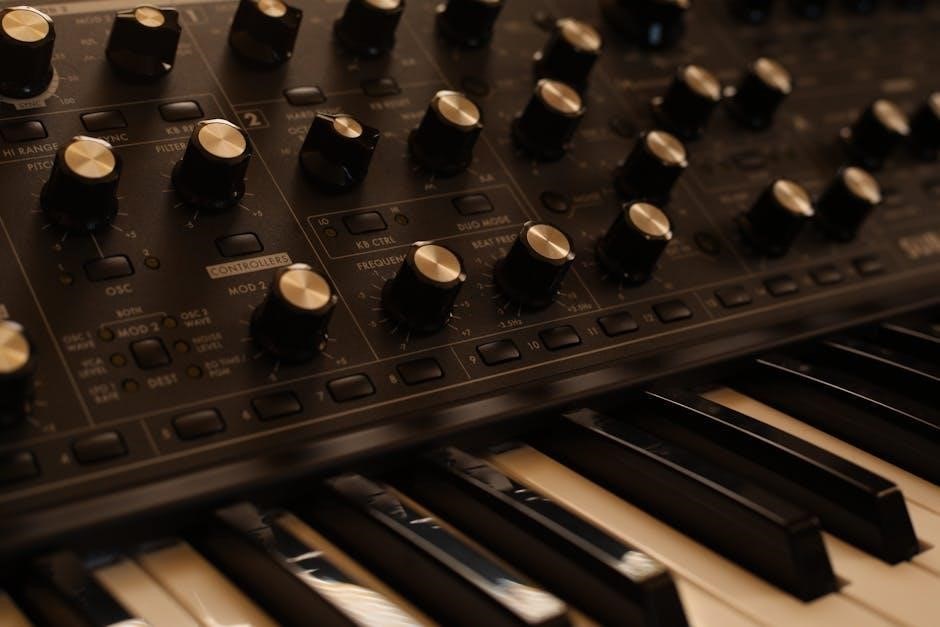
Nord Stage 4 Manual PDF: A Comprehensive Guide
Today, on 05/04/2026 at 03:27:20, we present this guide to unlock your Nord Stage 4’s potential, offering detailed instructions and insights for optimal performance.
Welcome to the world of the Nord Stage 4! This powerful instrument represents the culmination of decades of stage piano development, blending exceptional sound quality with an intuitive performance interface. This manual, available as a PDF, serves as your complete companion, guiding you through every facet of this flagship keyboard.
Whether you’re a seasoned professional or just beginning your musical journey, the Nord Stage 4 offers unparalleled versatility. Explore its distinct sound engines – Piano, Organ, and Synth – each meticulously crafted to deliver authentic and inspiring tones. This guide will demystify the instrument’s features, empowering you to create and perform with confidence.
Prepare to delve into a comprehensive resource designed to maximize your Nord Stage 4 experience, unlocking its full creative potential through detailed explanations and practical examples.
What’s Included in the Nord Stage 4 Manual PDF?
The Nord Stage 4 Manual PDF is a thoroughly detailed resource, encompassing every aspect of the instrument’s operation. You’ll find comprehensive explanations of the hardware, including the panel layout, controls, and connectivity options. Detailed sections cover each of the sound engines – Piano, Organ, and Synth – outlining their parameters and functionalities.
Beyond the basics, the manual delves into advanced features like program creation, morphing, and the extensive effects section. It provides clear instructions on MIDI implementation, audio routing, and integration with Nord Cloud.
Furthermore, a dedicated troubleshooting section addresses common issues and offers practical solutions, ensuring a smooth and enjoyable user experience. The PDF format allows for easy searching and offline access to all information.
Understanding the Nord Stage 4 Interface
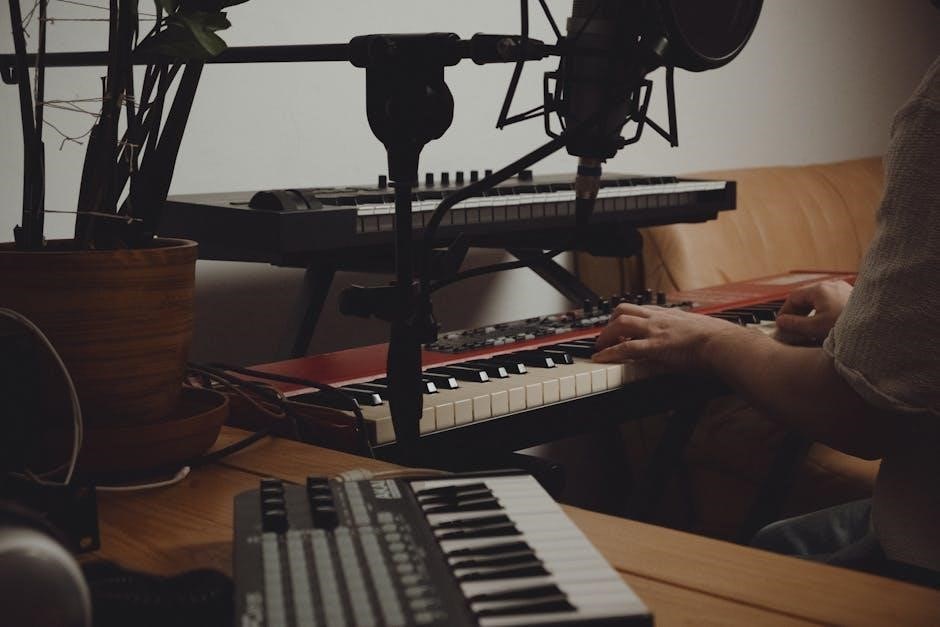
Mastering the Nord Stage 4 requires familiarity with its intuitive layout, responsive controls, and streamlined menu system for seamless sound creation and performance.
Panel Layout and Key Components
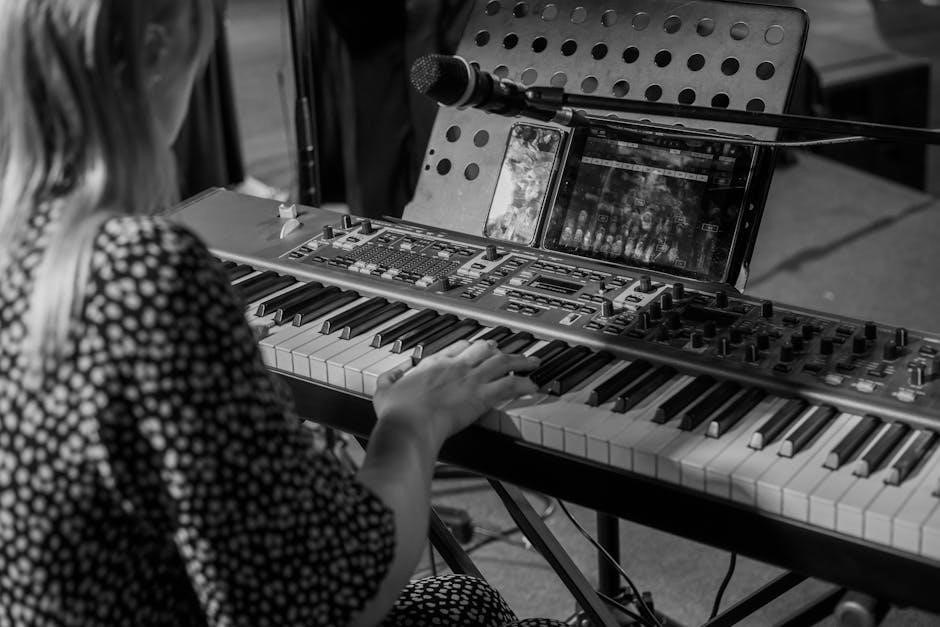
The Nord Stage 4’s control panel is meticulously designed for performance and intuitive operation. Central to the interface are the dedicated sections for Piano, Organ, and Synth, each with its own distinct controls.
You’ll find physical drawbars for the Organ section, allowing for real-time tonal shaping. The Piano section features dedicated buttons for selecting sounds and adjusting parameters like dynamic response. The Synth section boasts modulation controls and waveform selectors.
Key components include the pitch bend and modulation wheel, the master volume knob, and the category buttons for quickly accessing different sound categories. The OLED display provides clear visual feedback of selected parameters and settings. The panel’s layout prioritizes immediate access to essential controls, facilitating a fluid and expressive playing experience. Understanding these elements is crucial for unlocking the instrument’s full potential.
Navigating the Menu System
The Nord Stage 4 utilizes a streamlined menu system, accessed via the ‘Menu’ button and navigated using the data wheel and selector buttons. The OLED display clearly presents menu options, categorized for efficient browsing.
The menu structure is hierarchical, allowing you to drill down into specific settings for each section – Piano, Organ, Synth, Effects, and System. Use the data wheel to scroll through options and the selector buttons to confirm your choices.
Contextual help is often available by pressing the ‘Shift’ key alongside a menu parameter, providing detailed explanations. Mastering the menu system unlocks advanced customization options, including program editing, system settings, and MIDI configurations. Refer to the manual’s index for specific parameter locations and detailed descriptions of each function.
Sound Engine Deep Dive
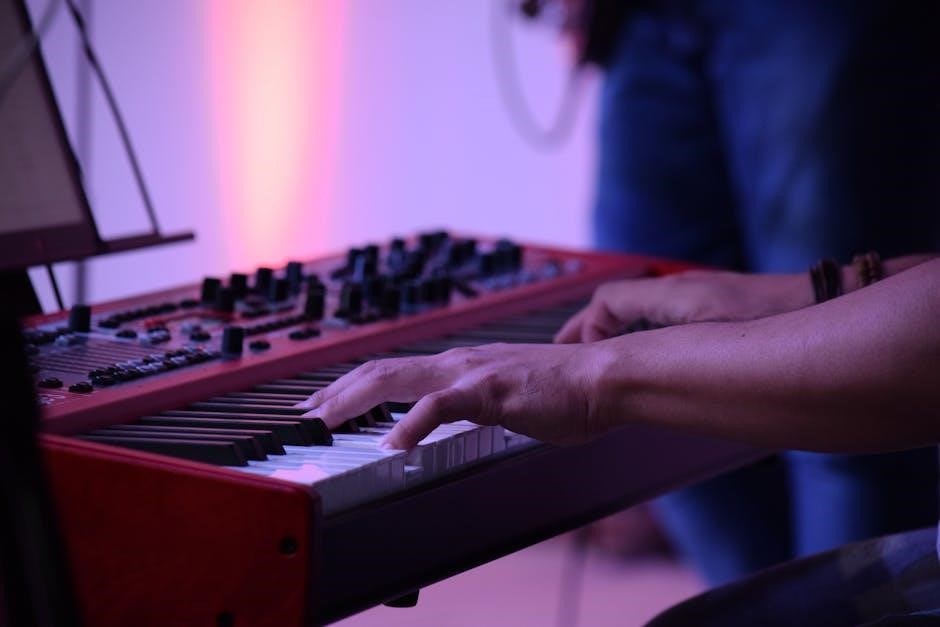
Explore the core of the Nord Stage 4: its powerful sound engines, encompassing advanced piano sampling, classic organ modeling, and versatile wavetable synthesis capabilities.

Piano Section: Sampling and Modeling
The Nord Stage 4’s piano section delivers exceptional realism through a combination of extensive sampling and advanced modeling technology; It boasts a vast library of meticulously sampled acoustic and electric pianos, capturing the nuances of each instrument with incredible detail.
Beyond sampling, the Stage 4 incorporates physical modeling, allowing for dynamic and expressive piano sounds that respond authentically to your playing style. This modeling engine simulates the complex interactions within a piano, creating a truly organic and responsive feel.
Users can layer multiple piano sounds to create rich and complex textures. The piano section also features customizable parameters, including string resonance, damper noise, and hammer response, allowing for precise tonal shaping. Explore the included factory piano banks or load your own samples for ultimate flexibility.
Organ Section: B3 Emulation & Drawbars
The Nord Stage 4’s organ section is renowned for its authentic emulation of classic tonewheel organs, particularly the legendary Hammond B3. At its heart lie meticulously crafted virtual tonewheels, recreating the characteristic warmth, grit, and subtle imperfections of the original instrument.
Central to the organ experience are the physical drawbars, providing immediate and intuitive control over the harmonic content of the sound. Adjust each drawbar to sculpt a vast palette of tones, from gentle, shimmering pads to aggressive, cutting leads.
Beyond the drawbars, the Stage 4 offers comprehensive control over percussion, chorus, and vibrato, allowing you to dial in the precise character of your organ sound. Multiple organ models are available, each with its unique sonic signature, and a rotary speaker simulation completes the authentic experience.
Synth Section: WaveTable Synthesis
The Nord Stage 4’s synth section delivers a powerful and versatile wave-table synthesis engine, offering a vast sonic landscape for creating everything from classic analog sounds to cutting-edge textures. Explore a comprehensive library of waveforms, meticulously sampled from vintage synthesizers and unique sources.
Dive deep into sound design with dual oscillators, flexible modulation options, and a dedicated filter section. Shape your sounds with resonant filters, envelopes, and LFOs, crafting dynamic and evolving textures. The synth section also features arpeggiators and step sequencers for creating intricate patterns and melodies.
Import your own waveforms to personalize your sonic palette further, and utilize the extensive modulation matrix to create complex and expressive sounds. The Nord Stage 4’s synth section is a playground for sonic exploration.

Editing and Customization
Unlock personalized soundscapes! This section details program creation, saving, and the innovative morphing function, alongside comprehensive effects editing capabilities.
Creating and Saving Programs
Program creation is central to the Nord Stage 4’s workflow. Begin by meticulously crafting your desired sound across the Piano, Organ, and Synth sections, adjusting parameters to achieve sonic perfection. Once satisfied, utilize the dedicated ‘Program’ buttons to store your creation.
The Nord Stage 4 allows for extensive program organization. You can name each program for easy recall and categorize them into various banks for streamlined access during live performance or studio sessions.
Saving options are flexible: overwrite existing programs, or save to an empty slot. The manual details how to utilize the program memory efficiently, including backup procedures to safeguard your valuable sounds. Explore the options for copying programs between banks and even sharing them with fellow musicians, expanding your sonic palette and collaborative possibilities.
Using the Morphing Function
The Nord Stage 4’s Morphing function unlocks dynamic performance possibilities. This powerful feature allows seamless transitions between two distinct sounds, controlled in real-time via the Morph Knob. Imagine blending a bright piano into a soaring synth pad – the Morphing function makes it effortless.
The manual details how to assign programs to the Morph destinations, defining the parameters that will change during the morph. Experiment with different combinations to discover unique sonic textures and expressive control.
Morphing isn’t limited to simple crossfades; you can control multiple parameters simultaneously, creating complex evolving sounds. Learn how to utilize the dedicated Morph Library to save and recall your favorite morphing setups, ensuring consistent performance and inspiring new creative ideas on stage or in the studio.
Effects Section: Modulation, Delay, Reverb
The Nord Stage 4 boasts a comprehensive effects section, offering a palette of sounds to enhance your performances. Explore a range of modulation effects – chorus, phaser, flanger, and tremolo – to add movement and texture. The manual details each effect’s parameters, allowing precise sculpting of your sound.
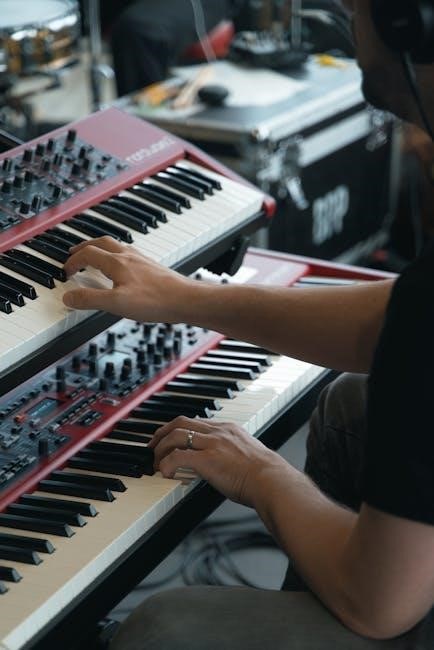
Delay and reverb options are equally extensive, from pristine digital delays to lush, vintage-inspired reverbs. Customize delay times, feedback, and reverb decay to create spacious atmospheres or subtle enhancements.
The effects can be routed in series or parallel, offering flexible signal processing options. Dedicated effect sends and returns allow integration of external effects pedals. The PDF manual provides detailed diagrams and explanations for optimal effect routing and utilization, maximizing sonic possibilities.
Connectivity and External Control
This section of the Nord Stage 4 manual PDF details MIDI implementation, audio connections, and seamless Nord Cloud integration for expanded control options.
MIDI Implementation and Control
The Nord Stage 4 manual PDF comprehensively covers its robust MIDI capabilities. It details how to utilize MIDI for controlling various parameters, including program changes, continuous controller assignments, and note messages. Explore how to map external MIDI controllers – keyboards, knobs, and faders – to seamlessly adjust sounds in real-time.
Understand the Nord Stage 4’s MIDI input and output configurations, enabling synchronization with other instruments and DAWs. The manual explains MIDI clock synchronization, allowing the Stage 4 to act as a master or slave device. Discover how to transmit and receive MIDI data via USB and traditional 5-pin MIDI connections. Furthermore, learn about MIDI filtering options to refine incoming MIDI signals and prevent unwanted parameter changes, ensuring a focused and controlled performance experience.
Audio Connections and Routing
The Nord Stage 4 manual PDF provides detailed guidance on establishing optimal audio connections. It outlines the various output options – balanced XLR and unbalanced ¼” jacks – for connecting to mixing consoles, amplifiers, and recording interfaces. Learn about stereo and mono output configurations, ensuring compatibility with diverse setups.
The manual thoroughly explains the Stage 4’s internal audio routing capabilities. Discover how to direct signals from different sections – Piano, Organ, and Synth – to specific outputs for flexible mixing and effects processing. Understand the headphone output options for private practice and monitoring. Explore the possibilities of utilizing the Stage 4 as an audio interface for direct recording into your computer, streamlining your workflow and achieving professional-quality sound.
Nord Cloud Integration
The Nord Stage 4 manual PDF details seamless integration with Nord Cloud, Nord’s cloud-based service for backup, sharing, and discovery. Learn how to connect your Stage 4 to Nord Cloud, enabling automatic backups of your Programs and settings, safeguarding against data loss. Explore the benefits of sharing your custom sounds with the Nord community and downloading creations from other users.

The manual guides you through browsing and importing sounds directly from Nord Cloud via the Stage 4’s interface. Discover how to utilize the cloud for efficient library management and staying up-to-date with the latest sound offerings. Understand the subscription options available for Nord Cloud and how to maximize its features to enhance your creative workflow and expand your sonic palette.

Troubleshooting and Support
This section of the Nord Stage 4 manual PDF offers solutions to common issues, guides for resolving problems, and directs you to official Nord support resources.

Common Issues and Solutions
Encountering difficulties with your Nord Stage 4? This section addresses frequently reported problems and provides step-by-step solutions. A common issue involves MIDI connectivity; ensure correct cable connections and proper configuration within the Nord Stage 4’s MIDI settings, as detailed in the manual PDF.
Another potential problem is unexpected program behavior. Try reloading the program or performing a factory reset (refer to the manual PDF for instructions) if issues persist. Audio dropouts can often be resolved by optimizing USB buffer settings on your computer, if connected.
If the display freezes, a simple power cycle usually resolves the issue. For more complex problems, consult the comprehensive troubleshooting guide within the Nord Stage 4 manual PDF, or visit the official Nord website for FAQs and support forums. Remember to always back up your programs!
Downloading the Latest Manual PDF Version
Staying up-to-date is crucial! To access the most recent Nord Stage 4 manual PDF, visit the official Nord website at nordkeyboards.com. Navigate to the “Support” section, then select “Manuals” and locate the Nord Stage 4. Ensure you download the version corresponding to your specific Stage 4 model and firmware.
Regular updates include bug fixes, clarified explanations, and details on new features introduced through firmware updates. Downloading the latest PDF guarantees you have accurate information for optimal instrument operation. The PDF is typically a large file, so a stable internet connection is recommended.
Alternatively, you can often find links to the latest manual PDF on authorized Nord dealer websites. Always verify the source to ensure you’re downloading a legitimate and safe file. Keep a local copy for offline access!