
Cable Machine Workout Routine: A Comprehensive Guide
Discover a 6-day gym workout schedule, potentially in PDF format, designed to help you achieve your fitness goals utilizing cable machines for effective gains!
Cable machines represent a versatile cornerstone of modern fitness, offering a unique training experience distinct from free weights or traditional resistance machines. Unlike those methods, cables provide constant tension throughout the entire range of motion, maximizing muscle fiber recruitment and promoting enhanced hypertrophy and strength gains.
Accessibility is another key benefit; they are user-friendly for individuals of all fitness levels, from beginners to seasoned athletes. A PDF guide to a cable machine workout routine can unlock this potential. The adjustable pulley system allows for a virtually limitless variety of exercises, targeting every muscle group with precision.
Furthermore, cable exercises often improve functional strength and stability, mimicking real-life movements more effectively. Whether you’re seeking a full-body workout or focused muscle isolation, a well-structured cable machine routine, potentially found as a downloadable PDF, can be a transformative addition to your fitness journey. They are a staple in many gyms and offer a safe and effective way to build muscle.
Benefits of Cable Training
Cable training delivers consistent tension, a significant advantage over free weights, leading to greater muscle activation and improved hypertrophy. This constant resistance challenges muscles throughout the entire exercise, maximizing fiber recruitment. A comprehensive cable machine workout routine PDF can illustrate this effectively.
Stability and control are also enhanced, reducing the risk of injury, particularly beneficial for beginners. The guided movement path promotes proper form, while the variety of angles achievable targets muscles from unique perspectives.
Functional strength is a key outcome, as cable exercises often mimic real-life movements; A well-designed PDF routine will incorporate exercises that translate to improved performance in daily activities. Moreover, cable machines are space-efficient and adaptable, making them ideal for home or commercial gyms. Utilizing a PDF guide ensures a structured and progressive approach to maximizing these benefits, leading to increased muscle mass and size.
Upper Body Cable Exercises
Explore a PDF showcasing exercises like cable flyes, presses, lat pulldowns, and seated rows, targeting chest, back, and shoulders for a complete upper-body routine!
Chest Exercises
Cable exercises offer a unique advantage for chest development, providing constant tension throughout the entire range of motion – a key element often missing in traditional weightlifting. A PDF guide dedicated to cable chest workouts will likely detail variations of cable flyes, emphasizing proper form: a slight step forward, handles grasped, and controlled movement to target all chest areas.
Furthermore, cable presses are invaluable, allowing for adjustments to target different chest angles. The PDF should illustrate how pulley height impacts muscle activation, with lower settings emphasizing the upper chest and higher settings focusing on the lower portion. These exercises, when incorporated into a structured routine, contribute significantly to increased muscle mass and size. Remember to prioritize controlled movements and proper technique to maximize effectiveness and minimize risk of injury, as detailed within the PDF resource.
Cable Flyes: Technique and Variations
Cable flyes, as detailed in a comprehensive PDF workout routine, are a cornerstone chest exercise. Begin by setting the pulleys at shoulder height, stepping forward, and maintaining a slight bend in your elbows. The key is to focus on squeezing the chest muscles as you bring your hands together. A PDF guide will likely emphasize a controlled movement, avoiding locking the elbows.

Variations are crucial for comprehensive development. The PDF may showcase incline cable flyes (lower pulley setting) for upper chest emphasis, and decline cable flyes (higher pulley setting) for lower chest targeting. A small step away from the stack, with hands facing towards the machine, optimizes middle deltoid engagement. Proper execution, as illustrated in the PDF, ensures maximum pectoral muscle activation and minimizes shoulder strain.
Cable Press: Targeting Different Chest Angles
A detailed PDF cable machine workout routine will highlight the cable press as a versatile chest builder. Unlike traditional presses, cables provide constant tension throughout the movement. Adjusting the pulley height allows for targeting different chest angles, a key component often detailed within the PDF.
Lower pulley settings emphasize the upper chest, mimicking an incline press. Conversely, higher pulley settings focus on the lower chest, similar to a decline press. The PDF may illustrate a neutral grip variation for increased pectoral activation and reduced shoulder stress. Maintaining proper form – controlled movements, engaged core – is paramount, as emphasized in the PDF’s instructional diagrams. This exercise, when incorporated correctly from a PDF guide, delivers a comprehensive chest workout.
Back Exercises
A comprehensive PDF cable machine workout routine dedicates significant attention to back development. Cable exercises offer unique advantages, allowing for unilateral work and constant tension, crucial for building a strong and defined back. The PDF will likely detail exercises like lat pulldowns, seated cable rows, and one-arm cable rows.
Variations in grip – wide, close, underhand – during lat pulldowns, as explained in the PDF, target different back muscles. Seated cable rows, with proper form focusing on squeezing the shoulder blades, are a staple. The PDF emphasizes isolating the lats with one-arm cable rows, promoting balanced development. These exercises, when followed from a detailed PDF guide, contribute to improved posture and overall back strength. Remember to consult the PDF for correct form and weight selection.
Lat Pulldowns: Wide Grip vs. Close Grip
A detailed PDF cable machine workout routine will thoroughly explain the nuances of lat pulldowns, specifically the impact of grip width. The PDF highlights that a wide grip emphasizes the outer lats, contributing to a broader back appearance; Conversely, a close grip, as detailed in the PDF, focuses more on the inner lats and lower back muscles.
The PDF will likely instruct users to experiment with both grips to achieve balanced development. Proper form, emphasized throughout the PDF, is crucial – maintaining a slight lean back and squeezing the shoulder blades together. The PDF may also include variations like underhand grip for increased bicep engagement. Understanding these differences, as presented in the PDF, allows for a more targeted and effective back workout. Always refer to the PDF for correct technique and progression.
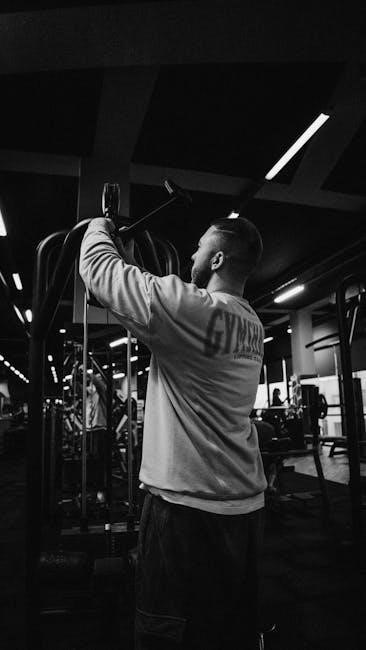
Seated Cable Rows: Proper Form and Muscle Engagement
A comprehensive PDF cable machine workout routine will detail proper seated cable row form, emphasizing a neutral spine and controlled movements. The PDF stresses engaging the lats, rhomboids, and traps – key upper back muscles. Maintaining a slight lean back, keeping the back straight, and pulling with the elbows are crucial, as illustrated in the PDF.

The PDF will likely advise against rounding the back or using momentum. It will explain how to initiate the pull from the shoulder blades, maximizing muscle activation. Variations, potentially included in the PDF, might involve different handle attachments to target specific muscle fibers. The PDF will also cover proper breathing techniques. Correct form, as demonstrated in the PDF, prevents injury and ensures optimal muscle engagement for a powerful and effective back workout. Refer to the PDF for detailed instructions.
One-Arm Cable Rows: Isolating the Lats
A detailed PDF cable machine workout routine will showcase the one-arm cable row as a superior exercise for isolating the latissimus dorsi. The PDF will emphasize maintaining a stable core and a neutral spine throughout the movement. Proper form, as illustrated in the PDF, involves pulling the handle towards the torso, focusing on squeezing the shoulder blade back and down.
The PDF will likely highlight the importance of avoiding rotation in the torso, keeping the elbow close to the body, and controlling the eccentric (return) phase. Variations, potentially included in the PDF, might involve different handle grips. The PDF will also cover proper breathing techniques. This exercise, when performed correctly as shown in the PDF, allows for a greater range of motion and enhanced muscle activation compared to traditional seated rows. Consult the PDF for a complete guide.
Shoulder Exercises

A comprehensive PDF cable machine workout routine will dedicate a section to shoulder exercises, emphasizing balanced development of all three deltoid heads. The PDF will detail exercises like cable face pulls, crucial for improving shoulder health and posture, and will explain proper form to target the rear deltoids effectively.
The PDF will also include cable lateral raises, focusing on the medial deltoid for shoulder width, and cable front raises, strengthening the anterior deltoid. The PDF will likely provide guidance on adjusting pulley heights to optimize muscle activation for each exercise. Expect detailed instructions, including recommended sets, reps, and rest periods, all within the PDF. The PDF may also include variations for each exercise to cater to different fitness levels. Proper technique, as illustrated in the PDF, is paramount to prevent injury and maximize results.
Cable Face Pulls: Improving Shoulder Health
A detailed PDF cable machine workout routine will highlight cable face pulls as a cornerstone for shoulder health and postural correction. The PDF will instruct users to set the pulley at face height and use a rope attachment, emphasizing external rotation throughout the movement.
The PDF will stress pulling the rope towards your face, separating the hands as you do so, and focusing on squeezing the rear deltoids and upper back muscles. Proper form, as illustrated in the PDF, is crucial to avoid shoulder impingement. The PDF will likely recommend 3-4 sets of 15-20 repetitions. The PDF will also explain how face pulls counteract the internally rotated shoulder position common from prolonged sitting or bench pressing. This exercise, detailed in the PDF, promotes balanced shoulder function and reduces injury risk.
Cable Lateral Raises: Targeting the Medial Deltoid
A comprehensive PDF cable machine workout routine will detail cable lateral raises as a prime exercise for developing well-rounded shoulders. The PDF will instruct users to attach a D-handle to the low pulley and stand perpendicular to the machine. Maintaining a slight bend in the elbows is crucial, as highlighted in the PDF.
The PDF will emphasize raising the arms out to the sides, keeping the palms facing down, until they reach shoulder height. Controlled movements are key, as the PDF will illustrate, to maximize medial deltoid activation and prevent momentum. The PDF will likely recommend 3-4 sets of 12-15 repetitions. The PDF will also caution against shrugging the shoulders during the exercise. This exercise, thoroughly explained in the PDF, builds shoulder width and contributes to overall upper body aesthetics, ensuring proper form for optimal results.
Cable Front Raises: Strengthening the Anterior Deltoid
A detailed PDF cable machine workout routine will showcase cable front raises as essential for anterior deltoid development. The PDF will guide users to attach a handle to the low pulley and stand facing the machine. Maintaining a slight bend in the elbows, as the PDF will demonstrate, is vital throughout the movement.
The PDF will instruct raising the arm straight in front of the body, keeping a controlled pace, until it reaches shoulder height. Avoiding swinging or using momentum is a key point emphasized in the PDF. The PDF will likely suggest 3-4 sets of 12-15 repetitions for optimal results. The PDF will also highlight the importance of engaging the core for stability. This exercise, thoroughly explained within the PDF, strengthens the front of the shoulder, contributing to a balanced and powerful upper body, ensuring proper technique for maximum effectiveness.
Lower Body Cable Exercises
Explore a PDF guide featuring cable kickbacks and squats, offering tailored resistance for glute and leg isolation, enhancing your lower body strength!
Glute Exercises
Maximize glute activation with targeted cable exercises detailed in a comprehensive PDF workout routine. The cable kickback stands out, allowing for a customized range of motion, unlike machine-restricted movements. This isolation focuses intensely on the glutes, promoting hypertrophy and strength gains.
A well-structured PDF will demonstrate proper form: a slight step away from the cable stack, hand facing inwards, and a controlled extension of the leg against resistance. Variations within the PDF might include adjusting cable height to target different glute fibers.
Furthermore, the PDF should incorporate cable squats, adding consistent tension throughout the movement. This enhances squat depth and overall leg drive. Detailed instructions and visual aids within the PDF are crucial for safe and effective execution, ensuring optimal glute engagement and minimizing injury risk. Remember to prioritize controlled movements!
Cable Kickbacks: Isolating the Glutes
Unlock peak glute activation with the cable kickback, a cornerstone exercise detailed within a comprehensive PDF cable machine routine. This movement uniquely allows a tailored range of motion, surpassing the limitations of traditional machines. A detailed PDF will illustrate the starting position: a small step away from the cable stack, hand facing the machine, and a slight drift of the arm ahead of the body.
The PDF should emphasize controlled leg raises against resistance, focusing on squeezing the glutes at the peak contraction. Variations, also outlined in the PDF, might include ankle strap adjustments for increased comfort and stability. Proper form, as visually demonstrated in the PDF, is paramount to prevent injury and maximize glute engagement.
This exercise effectively isolates the glutes, promoting targeted hypertrophy and strength development. The PDF will guide you through sets, reps, and rest periods for optimal results.
Cable Squats: Adding Resistance to Squats
Elevate your lower body training with cable squats, a dynamic exercise thoroughly explained within a detailed PDF cable machine workout routine. This variation introduces constant tension throughout the squat movement, enhancing muscle activation and overall effectiveness. The PDF will visually demonstrate proper setup, including cable positioning and stance width.
A comprehensive PDF guide will highlight the importance of maintaining a neutral spine and controlled descent. Variations, detailed in the PDF, may include different cable angles to target specific muscle groups. The constant resistance provided by the cable challenges stability and promotes functional strength.
The PDF will outline recommended sets, reps, and rest periods for optimal results, catering to various fitness levels. Mastering cable squats, as illustrated in the PDF, is crucial for building lower body power and endurance.
Leg Exercises
Unlock a powerful lower body with the leg exercises detailed in our comprehensive cable machine workout routine PDF. This section focuses on maximizing leg strength and definition through targeted movements; The PDF provides step-by-step instructions and visual aids for each exercise, ensuring proper form and minimizing risk of injury.
Explore exercises like cable leg extensions, focusing on quadriceps isolation, and cable hamstring curls, designed to sculpt the back of your legs. The PDF will explain how to adjust cable height and resistance for optimal muscle engagement. Furthermore, the PDF includes detailed explanations of cable squats, adding constant tension to traditional squats.

Our PDF also offers variations and progression strategies, allowing you to customize your workout based on your fitness level. Discover how to integrate these exercises into a complete leg day routine for noticeable results.
Cable Leg Extensions: Quadriceps Focus

Maximize quadriceps development with the cable leg extension exercise, thoroughly detailed in our cable machine workout routine PDF. This exercise provides constant tension throughout the range of motion, unlike traditional leg extension machines. The PDF illustrates proper setup, including ankle pad adjustment for comfort and stability.
Learn how to attach the ankle strap securely and maintain a controlled movement, focusing on squeezing the quadriceps at the peak contraction. Our PDF emphasizes the importance of avoiding hyperextension of the knee joint. It also provides guidance on selecting appropriate weight based on your strength level.
The cable machine workout routine PDF includes variations, such as single-leg extensions for increased intensity and muscle isolation. Discover how to incorporate this exercise into your leg day for optimal results and enhanced quadriceps definition.
Cable Hamstring Curls: Targeting the Hamstrings
Isolate and strengthen your hamstrings with the cable hamstring curl, a key exercise detailed within our comprehensive cable machine workout routine PDF. This variation offers a unique advantage over traditional hamstring curl machines by providing consistent tension throughout the entire movement.
The PDF provides step-by-step instructions on attaching the ankle strap correctly and maintaining a stable body position. Learn how to control the eccentric (lowering) phase to maximize muscle engagement and prevent injury. Proper form, as illustrated in the PDF, is crucial for effectively targeting the hamstrings.
Our cable machine workout routine PDF also outlines variations, including lying hamstring curls for increased range of motion and single-leg curls for enhanced isolation. Discover how to seamlessly integrate this exercise into your lower body routine for optimal hamstring development and balanced leg strength.
Core Cable Exercises
Explore our cable machine workout routine PDF for exercises like cable woodchops and Russian twists, designed to strengthen your obliques and core rotation!
Cable Woodchops: Oblique Strengthening
Cable woodchops are a fantastic core exercise detailed within a comprehensive cable machine workout routine PDF, effectively targeting your obliques for enhanced rotational strength and stability. To perform this exercise, adjust the cable pulley to a high position. Grab the handle with both hands, and stand with your side to the machine, feet shoulder-width apart.
Initiate the movement by pulling the cable diagonally across your body, as if chopping wood, rotating your torso and keeping your arms extended. Focus on engaging your obliques throughout the entire motion. Control the movement as you return to the starting position, resisting the pull of the cable. This exercise is excellent for developing functional strength, improving athletic performance, and sculpting a defined core. Varying the height of the pulley can target different portions of the obliques, providing a well-rounded workout. Remember proper form is crucial to avoid injury and maximize results, as outlined in the PDF guide.
Cable Russian Twists: Core Rotation

Cable Russian twists, often included in a detailed cable machine workout routine PDF, are a dynamic exercise designed to strengthen your core and improve rotational power. Attach a rope handle to the low cable pulley. Sit on the floor with your knees bent and feet slightly elevated, leaning back slightly to engage your core.
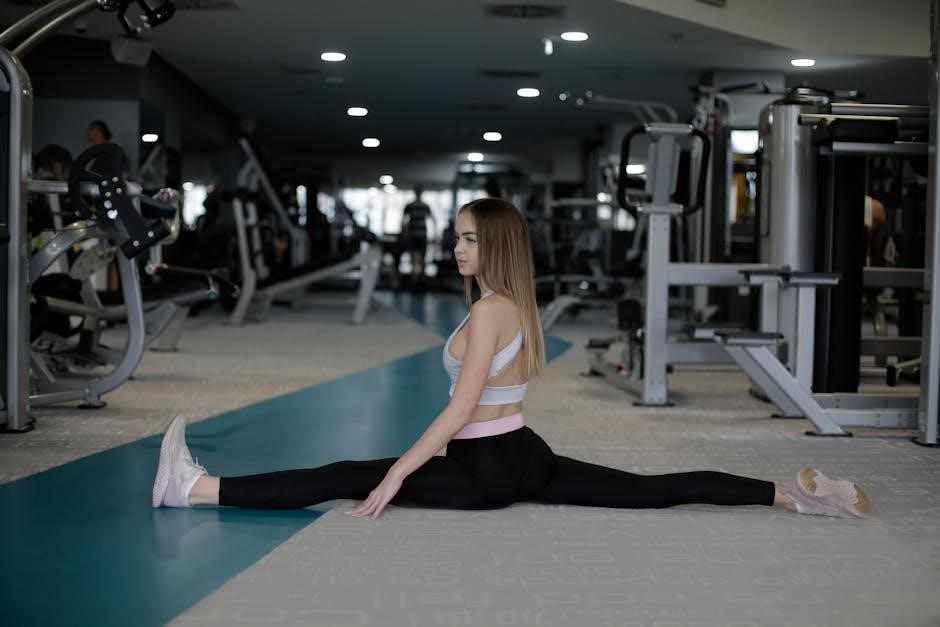
Hold the rope handle with both hands and twist your torso from side to side, bringing the handle towards each hip. Maintain a controlled motion, focusing on engaging your obliques and rectus abdominis. Avoid using momentum; the movement should be driven by your core muscles. This exercise is excellent for enhancing stability and improving performance in rotational sports. A PDF workout plan will often suggest varying the weight and repetitions to progressively challenge your core. Proper form is vital to prevent lower back strain, as detailed within the instructional PDF.
Creating a Cable Machine Workout Routine
Utilize a cable machine workout routine PDF to structure a 6-day program, incorporating warm-up and cool-down exercises for optimal results and recovery!
Sample Workout Split: 6-Day Program
Embark on a comprehensive fitness journey with a structured 6-day program, often available as a convenient cable machine workout routine PDF. This split allows for focused muscle group training and adequate recovery.
Day 1: Chest & Triceps – Cable Flyes, Cable Press variations.
Day 2: Back & Biceps – Lat Pulldowns (wide/close grip), Seated Cable Rows, One-Arm Cable Rows.
Day 3: Shoulders – Cable Face Pulls, Lateral Raises, Front Raises.
Day 4: Glutes & Hamstrings – Cable Kickbacks, Cable Squats, Hamstring Curls.
Day 5: Legs & Calves – Leg Extensions, Squats with cable resistance.
Day 6: Core – Cable Woodchops, Russian Twists.
Remember to consult a PDF guide or fitness professional for personalized adjustments and proper form. This program, often found in PDF format, maximizes hypertrophy, strength, and stability.
Warm-up and Cool-down for Cable Workouts

Prioritize injury prevention and enhanced performance with a dedicated warm-up and cool-down routine, often detailed within a cable machine workout routine PDF. A proper warm-up prepares muscles for exertion, while cooling down aids recovery.
Warm-up (5-10 minutes): Dynamic stretching like arm circles, leg swings, and torso twists. Light cardio, such as jumping jacks or high knees, increases blood flow. Perform a few sets of cable exercises with very light resistance.
Cool-down (5-10 minutes): Static stretching, holding each stretch for 20-30 seconds. Focus on the muscles worked during the session – chest, back, shoulders, legs, and core.
Refer to a PDF guide for specific stretches and recommendations. Consistent warm-up and cool-down routines, often outlined in a PDF, are crucial for long-term fitness success and injury mitigation.